I’m in the thick of it, working through another test.
This time, the exploration of writing a novel. I mentioned a few weeks ago that I was in pursuit, wondering if my previous experience in academic and memoir writing could be tapped to conjure a largely fictionalized story.
Along the way, writers will tell you about the curve balls, the speed bumps and the periodic (and yet persistent) insecurities about your lofty pursuit.
Some say stick with it, it needs to come out of you one way or another.
Some say the uncertainty is a byproduct of faulty structure – or lack of structure entirely.
Some say plot-driven is the only way to go, build the story accordingly.
Some say balderdash! Stories should be character-driven and as you come to know your fictionalized folks, the rest will follow…the story will unfold.
I know which way I lean (can you guess?) but I’m open to reading everything because I love crawling into writers’ processes. Sure, sure. The big guns – Stephen King’s “On Writing” and Anne Lamott’s beloved “Bird by Bird” are inspiration points I return to again and again. I like their voices, their honesty.
But what I’ve realized as I’m ¾ of the way through my latest project is that I’m curious about plot structure and scaffolding, too. Not so much that I’m gonna do it because I prefer listening to my characters, allowing them breathing room to reveal themselves as I type.
Before you think it/say it…you’re right. I’ve given my cast of…let me see…thirteen main characters and a few supporting players…a lot of liberty. I stare at descriptions of them, right now, on a messy 4×5 foot kraft paper “art installation” in my office. If I were an artist, I’d begin drawing faces next to the bullet point descriptions of my friends, but I’m not, so I periodically pause to look at the details they’ve already revealed about their personalities, their quirks, notable features. It’s like having company while I work – of the best variety. They speak only when spoken to. 😉
I’m what the experts would call a ‘character-driven’ writer, I suppose. But when I allow that awareness to seep in, I wonder if I’m neglecting the power of plot. I’ve got that, too (she says with a touch of indignation). Outlined in a few bullet points which stare back at me from my ‘character board’. I wonder about plot structure and resist it all at the same time.
I think I know why. Given my background in healing and helping professions, I’m very, very familiar with references to Joseph Campbell and “The Hero’s Journey”. I like it, but the idea of deploying it to aid my writing feels cumbersome and restrictive. On a personal growth level, I’m all in, but as an aide or inspiration to get this particular story out of myself as I type? Nope. The Call to Adventure, Refusal, Mentor Meeting, Tests, Challenges, Failures, Allies & Enemies, The Ordeal, The Reward, The Road Back, Rebirth/Renewal, The Return…it feels heavy. Too burdensome to contemplate. Intimidating, even? The last thing I need for inspiration.
But the good news is that’s not the only approach to story structure. In a recent article from B.A. Durham and the Chicago Writer’s Association, I learned about a popular (but unknown to me) plot structure from Japan: “kishōtenketsu”. New to you, too?
What I appreciated about Durham’s introduction to “kishōtenketsu” was the simplified structure, one where inherent conflict may or may not exist. Story for story’s sake without the heaviness of transformational moments, resulting from a hefty overcoming. Of something. Or someone.
Here’s the summary that Durham shared:
The organization of kishōtenketsu is incorporated into its name:
Ki: The introduction of the story where the characters are shown going about their ordinary lives.
Shō: The development stage of the story. A unique situation is presented and may take place chronologically before the first act.
Ten: The defining part of kishōtenketsu is the twist. In this part of the story something is revealed that changes the characters’ perspectives of the situation established in the second act.
Ketsu: The conclusion follows up on the twist in the third act. This act often shows the characters coming to grips with their new reality but not necessarily exhibiting any signs of change or growth.
Ordinary lives…situations…a twist…a conclusion. Fanfare optional. I’m far too much of a novice on the topic to say more but the point of this post is to share that I’m intrigued. Durham shares an additional resource in his article, written by Kim Yoon Mi. It’s one I’ve checked out and will return to.
Thanks so much for coming along. My characters are waving to you, thanking you for stopping by.
Vicki 😊
More about my writing adventures…
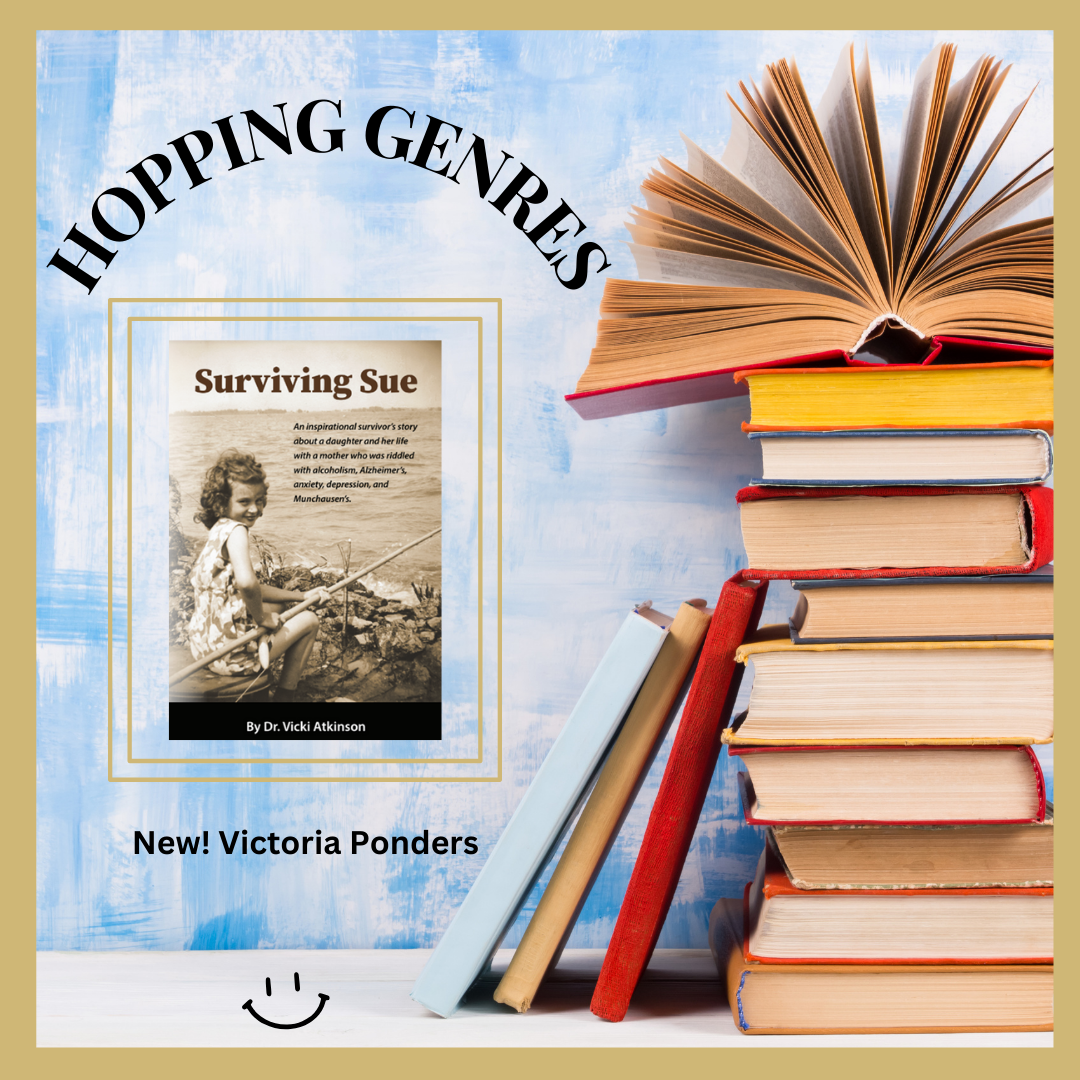
Check out this link for more about my book about my mother’s complicated life. My tale of resiliency: “Surviving Sue”.


 Victoria Ponders
Leave a comment