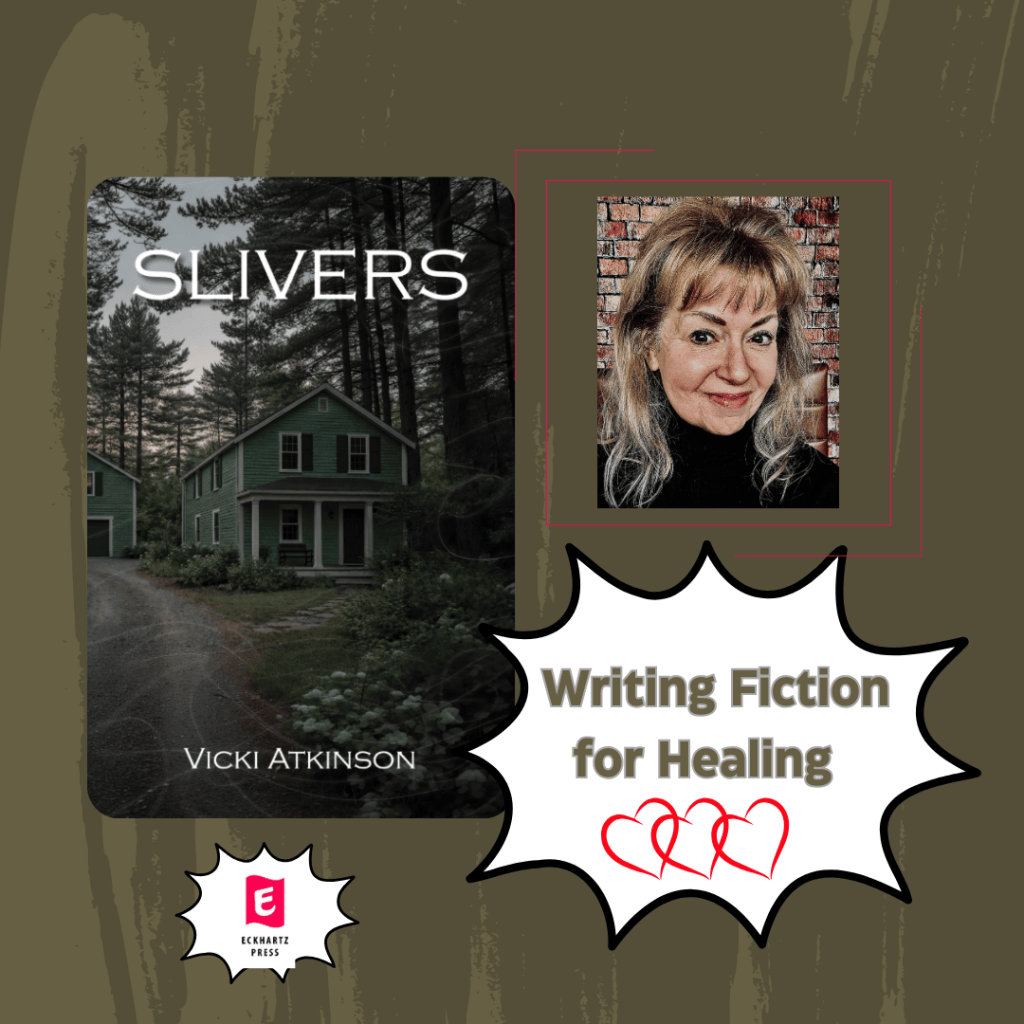
I love questions and comments from readers. Last week I had a delightful encounter with a former student, Daniel, who said:
“I just finished reading Slivers and my curiosity is getting the better of me. First off, I was surprised you wrote fiction and then I wondered if one of the characters was inspired by you. And that twist? Do you have time to talk?”
I loved his questions and the conversation they sparked.
We talked about fiction as a potent creative and therapeutic outlet because of the observational distance it affords. Stepping back to consider experiences from fresh vantage points—with the storytelling trajectory entirely in the writer’s hands.
As an early reader of Surviving Sue, Daniel said he was intrigued when Slivers debuted, wondering why I decided to write a novel after baring my soul in memoir. It seemed like a substantial shift, he said.
I explained, sharing my therapeutic belief in the power of expressive writing to reframe painful experiences. Writing fiction allows an author to uniquely explore the what-if questions with an eye on the rear-view mirror. Where we’ve been, what we’ve experienced in life.
Thank you, Dr. Pennebaker
My long-standing regard for the work of psychologist and educator, Dr. James Pennebaker, always provides encouragement. His research demonstrated the potency of narrative expression for lessening stress and bolstering confidence and courage. Of course it’s not a replacement for licensed mental health support, but leaning into a reflective writing practice–in any form–journaling, poetry, fiction, memoir–can be a means for relieving symptoms, gaining clarity.
Before I launched my enthusiastic sermonette about famous, prolific authors who’ve used aspects of their own lives for fiction fodder (Joan Didion, Ernest Hemingway, Maya Angelou…there are plenty), I returned to Daniel’s curiosity:
“Who might Vicki be…as a character in Slivers?”
His guess?
“Katie.”
“Or maybe Clarissa,” he said. “They both seemed fearless.“
I smiled and shook my head, enjoying his guesswork. Two strong female characters, but Katie and Clarissa were drawn from dear ones—I wasn’t the inspiration.
“Oh,” he said. “Wait. You mean Jane. She was inspired by you? “
I smiled again.
“Yep. Our anxiety-ridden conflicted heroine. With a sprinkling of traits pulled from others.”
This time he smiled.
Learning from author and therapist Emily Howes
While catching up with Daniel, I remembered the work of therapist and author Emily Howes and mentioned her book to him. Howes wrote The Painter’s Daughters, a fictionalized account of the daughters of famous 18th century portrait painter Thomas Gainsborough.
Former art history major Daniel lit up and I shared more…
Howes’ views about writing fiction for personal growth are motivational and invitational:
“To my telling of this beautiful story of sisterly love, I bring my own inherited sense of the panic and confusion…I find words to shape something of that experience…I find a kind of healing.”
“We can uncover stories we have told about ourselves that we didn’t even know were there.”
“We can dismantle old narratives and form new ones.”
“Through these delicate, chiasmatic relations with each other, we can find our selfhood reflected back to us and find a way to make peace with hidden things by bringing them out into the light and acknowledging them as part of our narrative.”
“Writing became a kind of therapy for me in bringing to life my own family history and helping me to uncover parts of it I had not known were still with me.”
Mark Petruska Appreciation Moment
Before we finished our chat, Daniel offered a shout out to my friend and fellow author and blogger, Mark Petruska. In Mark’s review of Slivers, he offered a terrific, concluding reminder:
“P.S. Be sure to read the author’s note at the end. While not part of the actual novel, it offers a pretty fun twist that will make you look at the story with a newfound appreciation.“
Note to self! Daniel and others may have missed the hidden nugget in the “Author’s Notes”. When Daniel returned to read about the “twist” after seeing Mark’s review, he needed to know more. About how Slivers came to be and what I thought of the discovery about my mom’s family and ultimately if I felt an additional sense of closure about Sue. I am so grateful that Daniel reached out.
Readers’ questions and enthusiasm are like unexpected gifts in this writer’s journey of self-understanding. Thank you for being here and allowing me to share.
-Vicki 💝
Literary Hub » What Fiction Writing Shares With Psychotherapy
The Painter’s Daughters: A Novel: Howes, Emily
Opening Up by Writing It Down: How Expressive Writing Improves Health and Eases Emotional Pain
Hi – I’m Victoria, Vicki, Dr. Vicki. I hold a doctorate in Adult Education and I’m a Licensed Professional Counselor (LPC), and author of Surviving Sue and Slivers.
Check out this link to learn more about my book Surviving Sue – all about resilience and love. Check out this link to order Slivers…a ghost story with surprising twists. Click here for the interview with my publisher, Rick Kaempfer from Eckhartz Press.
Copyright ©2026 victoriaponders.wordpress.com – All rights reserved


Leave a Reply