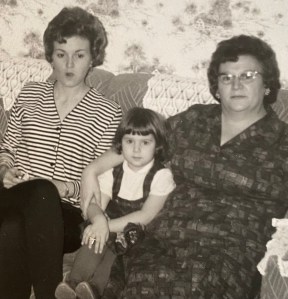
I’ve been thinking about this photo for years. It’s a snap of me – maybe at five years old – sitting alongside my mom and Nanny. Three generations of stressed out, angry eaters. Mom (Sue) is the one in the striped sweater, sucking on a hard candy, frustrated and desperately trying to avoid the tray of cookies on the coffee table.
I don’t remember the holiday or occasion, but it was one of many forced celebrations that did little to cloak layers of unresolved conflict. My mom and Nanny didn’t get along and yet they saddled up for holidays and birthdays and pretended to be okay with each other.
Mom was angry at Nanny, and it always seemed to be food related. Desperately trying – for decades – to be anything OTHER than what her food obsessed mother became. Nanny hated photos and always pulled one of the grandkids close to her. Not in an affectionate way but as a shield. Helping to disguise her size or just buffering herself from the animosity with her daughter?
I learned to sit with my hands folded, knees together, like a prop, but I tuned into the undercurrents between them. Curious and sometimes fearful of their rage and rules about food. Questions about quantity. Quibbling about overeating…whispers of purging.
You may be thinking, ‘Thanks Vicki, but why the disclosure? I’m learning that my family is far from unique and sharing is helpful to others. Families and generational food issues? They are endlessly intertwined and when you add the individualizing sprinkles of perfectionism, competition, compulsion and fear that drive disordered eating, it’s clear the narratives are layered and complex. What matters most? A listening ear, a helping hand. Attention and love in order to help empower and normalize. You’re not alone.
If we could wrap one another up in bubble wrap, maybe the road to recovery would be more straightforward. Unrealistic, I know because the media assaults and ignorance about disordered eating are rampant and at their worst, they offer overly simplistic solutions that often result in shame, recoil and withdrawal for those suffering. Understanding the destructiveness of social media and reality tv is crucial. It’s unrelenting and it’s not gender specific.
Check out the links at the end of this post for comprehensive resources, but if you’re in a “TLDR” mood 😊take a gander at these five tips from NEDA (National Eating Disorders Association) to inspire critical thinking and active dialogue to challenge unrealistic portrayals of body ideals. Let’s encourage more natural and diverse body images in media (Ozempic be damned).
5 TIPS FOR MEDIA SELF CARE
- Choose and use media mindfully. Be selective about your media use and choose media that supports your values and builds self-esteem and body confidence.
- Limit screen time and social networking. Researchers studying body concern issues have found that the more time we spend in the media world, the more we are exposed to body perfect images, and the more vulnerable we are to compare our appearance to unrealistic body standards. Protect your self-image by monitoring the quantity and quality of your mainstream and social media time.
- Test the message for body positivity. Use media literacy strategies to think critically about messages you consume and content you create on social media. Test for body positivity by asking key questions: Are the body depictions realistic or digitally altered? What does the message really mean? Why are they sending it? How might it affect someone’s body acceptance? Who created and profits from the message? Before you text, tweet, post comments, and share photos and videos, ask yourself why you are sending the message, who you want to reach, and analyze its body positivity.
- Talk back to media about body image. Tell people who profit from media and establish policies what you like and don’t like about their body representations, why you feel this way, and what you plan to do about it — take a stand and refuse to read, view or listen to media or buy advertised products until they make changes.
- Advocate for positive body talk. Use your social media capital to inspire others to use their voices to compliment authentic and diverse body messages, criticize unrealistic body ideals, and report body shaming. Shout out to media outlets, retailers, advertisers, and celebrity product endorsers who celebrate natural looks, healthy body size, and diverse body shapes, and call out ones that continue to promote unhealthy and artificial body norms. You can make a difference!
What else?
- Need a nutritional booster shot? This piece from the Cleveland Clinic is excellent because it’s comprehensive and encouraging. Check it out.
- Support and Resources: National Eating Disorders Association
-Vicki ❤


 Victoria Ponders
Leave a reply to Dinner at Breakfast – Victoria Ponders Cancel reply